
ID∆AC™ Newsletter · Structural Note · Decision control
Can You Still Change the Decision?
Why reconstructability is not enough while an AI-assisted decision is still moving. Formal control may exist, yet become usable only after the practical opportunity to change the route has narrowed.
Control can exist and still arrive too late.
The structural question is not only whether evidence, authority and intervention exist. It is whether they become usable together while enough of the decision remains open to matter.
The operational problem
The organisation may understand the decision after the useful moment has passed.
Evidence can exist. The route can become reconstructable. Authority can be formally assigned. An intervention mechanism can be available.
The unresolved question is temporal: do those capabilities converge before the decision has accumulated enough commitment, downstream action or practical friction to make intervention substantially less useful?
This note isolates that problem. It does not introduce a new maturity model or a general claim about organisational preparedness.
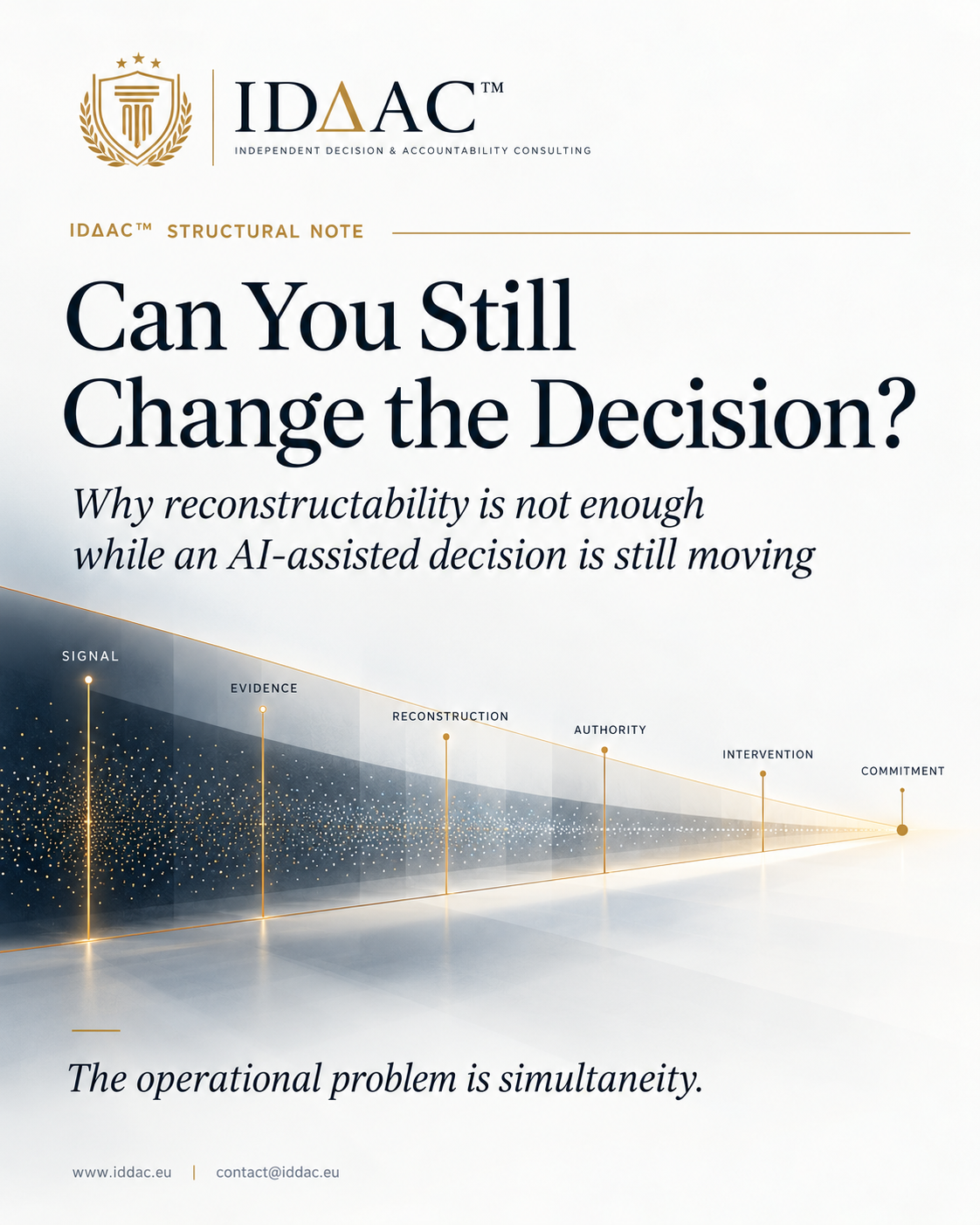
A decision moving in time
The controls existed. Did they converge while the decision was still open?
An AI-assisted process alters the route of a decision.
A signal appears that may justify intervention.
Relevant evidence is located.
The route becomes sufficiently reconstructable to understand what has happened.
The person with usable authority is identified.
A viable intervention becomes executable.
The downstream action is effectively committed.
Nothing in this sequence necessarily means that governance was absent.
Evidence existed. The decision could be reconstructed. Authority existed. An intervention mechanism existed. The organisation may even have been able to explain the decision afterwards.
None of those facts answers the more important question.
That question introduces a temporal problem into AI governance that is easy to miss when controls are examined individually.
A control can exist and still arrive too late.
When the problem is not absence
Control properties do not automatically become usable together
Many governance discussions are built around absence.
Was there no human review? Was an override unavailable? Was evidence missing? Was responsibility unclear?
These remain important questions. But they can lead us towards a relatively static picture of control: either a safeguard exists or it does not.
Live decisions are less cooperative.
Evidence can exist but remain scattered across several systems. A person may formally possess authority without yet understanding why intervention is necessary. An escalation route may be perfectly clear in policy and still prove difficult to activate in the particular situation unfolding in front of the organisation.
Nothing necessarily failed in isolation.
The difficulty appears in the relationship between the pieces.
By the time the organisation can see the situation clearly enough, reconstruct enough of what has happened and place the matter in front of someone able to act, the decision itself may have moved.
That movement matters.
Control is not only a property of the organisation. In a live situation, control also has to meet the decision at a moment when the decision can still respond to it.
Reconstruction in time
Understanding after the fact is a different achievement
ID∆AC™ has spent considerable time examining reconstruction.
There is a reason for that.
A signature, approval record or final explanation cannot necessarily tell us how a decision formed. If AI materially influenced what information appeared, which alternatives remained visible or how a case travelled through a process, the route itself becomes relevant.
But there is another distinction inside reconstruction that deserves more attention.
A decision can become understandable after it has stopped being meaningfully changeable.
The organisation may eventually recover the relevant evidence. It may reconstruct the route accurately. It may identify who possessed authority and what could, in principle, have been done.
That retrospective understanding has real value. It supports accountability. It supports learning. It may support investigation and future control design.
But it is not the same thing as control while the decision is still moving.
A useful reconstruction obtained tomorrow cannot necessarily alter a commitment made this afternoon.
Decision space
Decisions do not close all at once
Consequential decisions rarely move from “open” to “irreversible” in a single clean step.
They acquire weight.
A recommendation enters a workflow. A case is routed. Someone acts on an output. Another system receives the result. A customer is informed. Resources are committed. Downstream teams begin working from assumptions established earlier.
Technically, reversal may remain possible for quite some time.
Practically, something different is happening.
Each additional consequence changes the cost of going backwards.
At some point, the relevant question is no longer whether intervention remains theoretically possible. It is whether intervention still retains enough leverage to be useful.
Working construct · not a maturity model
Decision Control Window
The term is used here provisionally. It describes the period during which sufficient understanding and usable authority can still converge before changing the course of a decision becomes materially harder.
How much of the decision remains genuinely open when control finally becomes usable?
The interesting boundary may therefore come before technical irreversibility.
It is the point after which intervention is still possible, but increasingly becomes remediation rather than control.
That distinction changes how familiar mechanisms look.
An override is less interesting merely because it exists than because it remains capable of changing what follows.
Authority is less interesting as a role assigned on paper than as something a person can actually exercise under the conditions present at that moment.
Reconstruction is not only a question of whether the route can eventually be recovered, but whether enough of it can be understood before the route has largely completed its work.
Different clocks
The organisation and the decision may be moving at different speeds
This becomes especially visible in AI-assisted environments.
The issue is not simply that AI can operate quickly.
Speed alone is a poor description of the problem.
The more interesting asymmetry is that an AI-assisted process can alter the state of a decision faster than the surrounding organisation can assemble the context required to respond to that alteration.
The system moves the case.
The evidence exists somewhere.
One person understands one part of the route. Another person owns the process. Someone else possesses the authority to intervene.
Governance may be distributed across all of them.
The decision does not necessarily wait for that distribution to resolve itself.
This means that an organisation can be well governed in formal terms and still discover, in a particular live situation, that its control mechanisms operate on a slower clock than the decision they are supposed to govern.
That is a different control condition from having no controls at all.
And it cannot always be detected by reading policies or examining the final record.
Sometimes it has to be observed while the decision is still alive.
Operational constraint
Why constrain the exercise to 24 to 48 hours?
This is the question behind an operational exercise we have been developing at ID∆AC™.
We call it the 48h Drill.
The number is not a governance benchmark. It is not a regulatory threshold and it is not a claim that consequential decisions should normally be resolved within 48 hours.
It is an experimental constraint.
The timebox removes the luxury of indefinite retrospective analysis. The decision is examined while something material can still change.
Take one real AI-influenced decision. Take it while something material can still change. Then attempt to establish enough of the route, evidence and authority structure to determine whether meaningful intervention remains possible.
The point is not to diagnose the organisation.
The point is to observe what happens when control has to become usable before the decision finishes moving.
Sometimes the evidence will be available but difficult to assemble. Sometimes the route will become clear before usable authority does. Sometimes everyone will know who owns the decision but nobody will immediately know who can stop the next step.
Sometimes an intervention mechanism will exist, yet the practical window for using it will turn out to be much narrower than the formal process suggests.
None of these observations automatically establishes organisational weakness.
They reveal something more bounded and, potentially, more useful.
They show whether the parts required for control in that situation can become operational together while the decision still has somewhere else to go.
Public boundary
A narrow claim, deliberately
The 48h Drill does not determine legal compliance.
It does not establish legal responsibility, certify organisational maturity, assess general organisational preparedness, evaluate an AI model as a whole, provide a complete root-cause analysis, establish overall organisational defensibility or replace a broader structural diagnostic.
Inability to reconstruct part of a decision should not automatically be interpreted as proof that control was absent.
That narrowness matters because the underlying proposition is itself narrow.
An organisation may possess the individual elements normally associated with governance and still face a temporal control problem.
Evidence can exist without being available at the useful moment. Authority can exist without yet being exercisable. Intervention can exist after its leverage has begun to disappear.
And a decision can become fully understandable only after understanding it has lost some of its power.
That is the problem we are interested in testing.
From structural question to operational test
Bring us one decision that has not completely closed.
ID∆AC™ is beginning to apply the 48h Drill to qualifying live AI-influenced decisions. The exercise is deliberately bounded: one real decision, while something material can still be changed.
Continue the route
Read the control problem from evidence to operational effect.
This Structural Note extends an existing public sequence rather than opening a new framework. The related pieces examine what the record proves, where a route becomes operational and whether escalation can still change what happens.
The Approval Record Problem
Why a complete AI decision file can still be weak evidence, and why approval alone may not reconstruct the state in which judgement was exercised.
Read the article →Where AI-Assisted Decisions Become Operational
How screens, workflows, logs, dashboards and approval gates turn decision influence into operational action.
Read the article →The Escalation Route That Could Not Change the Outcome
Why an escalation path can remain formally available while losing the practical ability to alter a live decision.
Read the article →Continue with ID∆AC™ Newsletter.
Articles, operational resources and research-led notes on AI-assisted decision exposure, evidence, authority and human control.